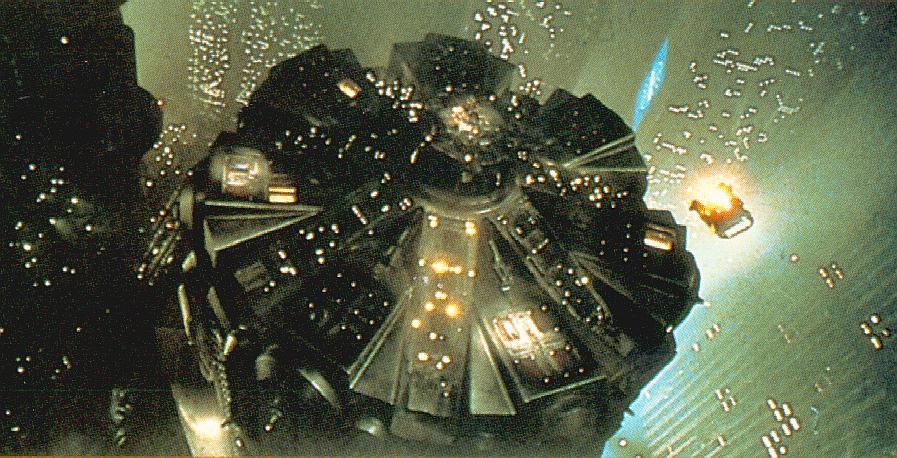
Fritz Lang’s 1927 science fiction movie Metropolis seems to have set standards for later works in a variety of aspect. Numerous shots, as for example of the city or the robot man’s creation reminded me of later science fiction movies, such as Blade Runner (1982) or The Fifth Element (1997). The movie’s epic ambition is revealed not only in the impressive sets but also the amount of actors involved and the pioneering special effects.
Metropolis portrays a world of opposites: the elite of society lives in a Utopian future city while the working class is confined to a life below the surface, the elite enjoys the wonders of modern technology while the workers are no more than another link in the gray monstrous machine that keeps the city alive. The descent of Freder, a son of the elite, into the underworld, where he is exposed the workers condition, and the creation of the “robot man” eventually lead to a revolution that is resolved by Freder as the “mediator,” the “heart,” between “head,” the ruling class, and “hands,” the working class.
Numerous pioneering effects emphasize the movie’s dialectical theme. Crooked tunnels and dark shadows (46:20) dominate the workers’ city while clean angles and bright light underline the elite’s life of leisure. The workers’ machine-like movement reveals their merging with the city’s engine (15:22) while young “Abercrombie models” train their divine bodies in the Utopia Olympics upstairs.
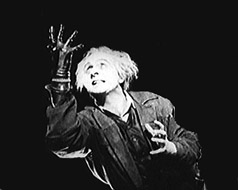
Similar to the other silent movies I have seen in this class (Sunrise, The Cabinet of Dr. Caligari), the acting is quite dramatic, in particular in the case of Rotwang, the crazy scientist. Another indicator that the movie is still an exploring work in the new field of movie-making is that the whole movie is structured as a classical symphony (prelude-intermezzo-furioso etc). Supported by the musical framework, the movie evolves towards its stunning climax. The cross-over between movie and narrative was another interesting aspect of the movie. At times, a scene was interrupted by a short slide that summarized what was happening at a different location. This slightly unusual narration of the plot might be due to the loss of several scenes.
I found several scenes that where adopted by later movies. The opening shots of the upper city, introducing the gigantic skyscrapers, infinite narrow bridges, and various aircrafts composing the future city finds its copy in numerous movies, such as The Fifth Element and Blade Runner. The Fifth Element also seems to have copied elements of the machine man’s creation scene (1:15:05). Moreover, Star Wars’ C3PO shows a strong resemblance to the original machine “man.” Rotwang, the creator of the machine man, appears to be the model for numerous “mad scientist” characters in later movies, for example Back to the Future series (1985, 1989, and 1990). I’m sure even more references can be found but these caught my attention right away.
Altogether, Metropolis struck me as an impressively epic movie, considering the technical limitations of 1927. The huge cast, vast sets, and note-worthy special effects play its part in the ground-breaking effect the movie has had on later work. At times, the number of parallel plots and the missing scenes made it difficult to follow the story line; yet, the theatrical acting and soundtrack maintain the suspense on a high level throughout the movie’s two hours of futuristic class struggle.
***
Compared to Metropolis’ 1927 high-end visuals, The Cabinet of Dr. Caligari (Caligari) appeared rather antiquated. However, the rough appearance of the 1919 horror movie played right into its surreal, Dadaist atmosphere. I agree with Krystal’s point that Caligari ‘s infusion of horror differs strongly from “modern” horror movies. Yet, the only scene that actually felt like a modern horror movie was the exact scene in which Cesare is approaching Jane’s bed (0:42:56). The scene strongly reminded me of a scene from The Strangers (2008), a rather disappointing movie. Part of that scene can be found on 0:50 of the trailer, in case you are interested.
Similar to Metropolis, Caligari also uses a different medium as structural support, as the movie is divided into acts, similar to a theater play. The funky jazz music as a substitute to the characters’ conversations appeared quite unfamiliar in the beginning but once I adapted to the movies surreal dimension it seemed quite appropriate.
Caligari has certainly inspired numerous later works in the horror genre. Rob Zombie’s House of a Thousand Corpses (2003) comes to my mind, as it deliberately applied similarly rough visuals in order to create a quite surreal atmosphere.
In the end, I must say I enjoyed watching both movies and I feel more curious about silent movies of the 1920s. Unfortunately, we don’t have the resources to afford some antique cameras that we could use for our movies. That would be quite something!





Subscribe to:
Post Comments (Atom)
No comments:
Post a Comment